How Many Tiles Do I Need? Room Size Calculator Guide
You're standing in the tile aisle, phone in one hand, tape measure in the other, and one question looping in your head. This guide answers it — fast, then properly.
The 30-second answer
A 12×12 ft room with standard 12×12 inch tiles:
159 tiles → 16 boxes (of 10)
144 × 1.10 (waste) = 158.4 → round up to 159
Different room? Different tile? Keep reading — the full method takes three minutes and works for every room you'll ever tile.
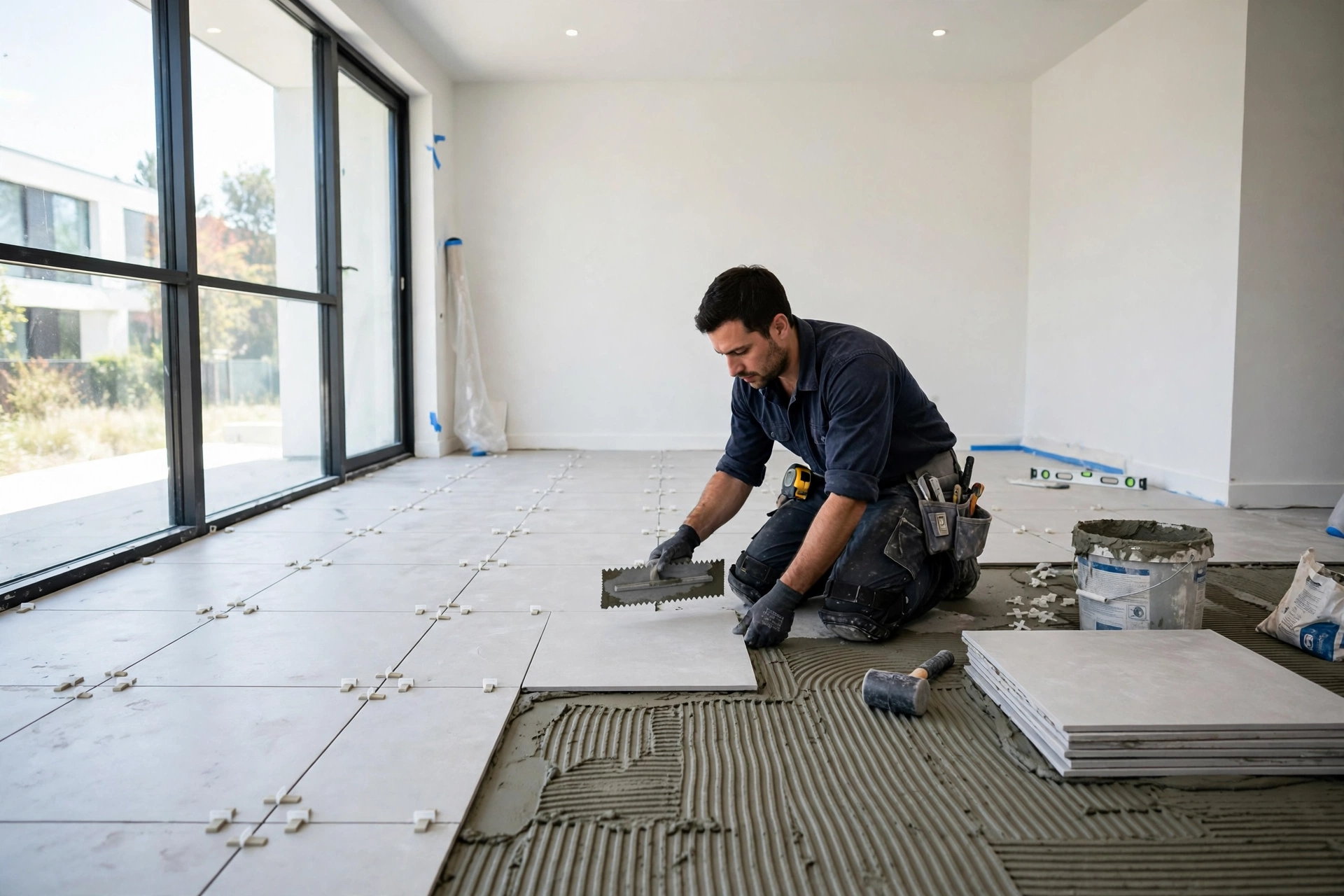
Here's how this guide works. Instead of a dry formula dump, we'll walk through it the way it actually happens: as seven questions people ask at the tile store counter — in the order they ask them. By question seven, you'll know your exact number.
Question 1: "How do I measure my room?"
Grab a tape measure and get two numbers: the length and width of the floor in feet. Measure wall to wall at the longest points. Don't subtract for doorways or closets yet — small cutouts get absorbed by the waste margin, and overcomplicating the measurement is how people end up short.
Room area is simply:
A 12×10 ft kitchen is 120 sq ft. A 8×6 ft bathroom is 48 sq ft. That's the whole trick for rectangular rooms — and most rooms are close enough to rectangles.
What if my room is L-shaped?
Split it into two rectangles on paper, measure each, and add the areas. A hallway that's 10×4 ft with a 6×4 ft alcove becomes 40 + 24 = 64 sq ft. Two minutes with a sketch saves a second trip to the store. For trickier layouts, the free Square Footage Calculator measures L-shapes, circles, and triangles directly.
Question 2: "Does the tile size change the math?"
Yes — this is the step most people skip, and it's where wrong answers come from. A tile's coverage depends on its area, and tile sizes are sold in inches while rooms are measured in feet. Convert first:
Then: tiles needed = room area ÷ one tile's area.
| Tile size | Area per tile | Tiles per sq ft |
|---|---|---|
| 6×6 in | 0.25 sq ft | 4 |
| 12×12 in | 1 sq ft | 1 |
| 12×24 in | 2 sq ft | 0.5 |
| 16×16 in | 1.78 sq ft | 0.56 |
| 18×18 in | 2.25 sq ft | 0.44 |
| 24×24 in | 4 sq ft | 0.25 |
So that 12×12 ft room (144 sq ft) needs 144 of the 12×12 tiles — but only 64 of the 18×18 tiles (144 ÷ 2.25), or 36 of the big 24×24 format. Same floor, wildly different box counts. Always do the division with your tile size.
A worked example: the 18×18 tile
Say you fall in love with 18×18 inch tiles for that same 12×12 ft room. One tile covers 2.25 sq ft, so 144 ÷ 2.25 = 64 tiles exactly. With a 10% waste margin: 64 × 1.10 = 70.4 → 71 tiles. If they come 8 per box: 71 ÷ 8 = 8.875 → 9 boxes. Notice how the bigger tile nearly halves your box count — fewer grout lines, faster install, but each cut piece wastes more material, so don't drop below 10% waste even in a simple room.
Question 3: "How much extra should I buy?"
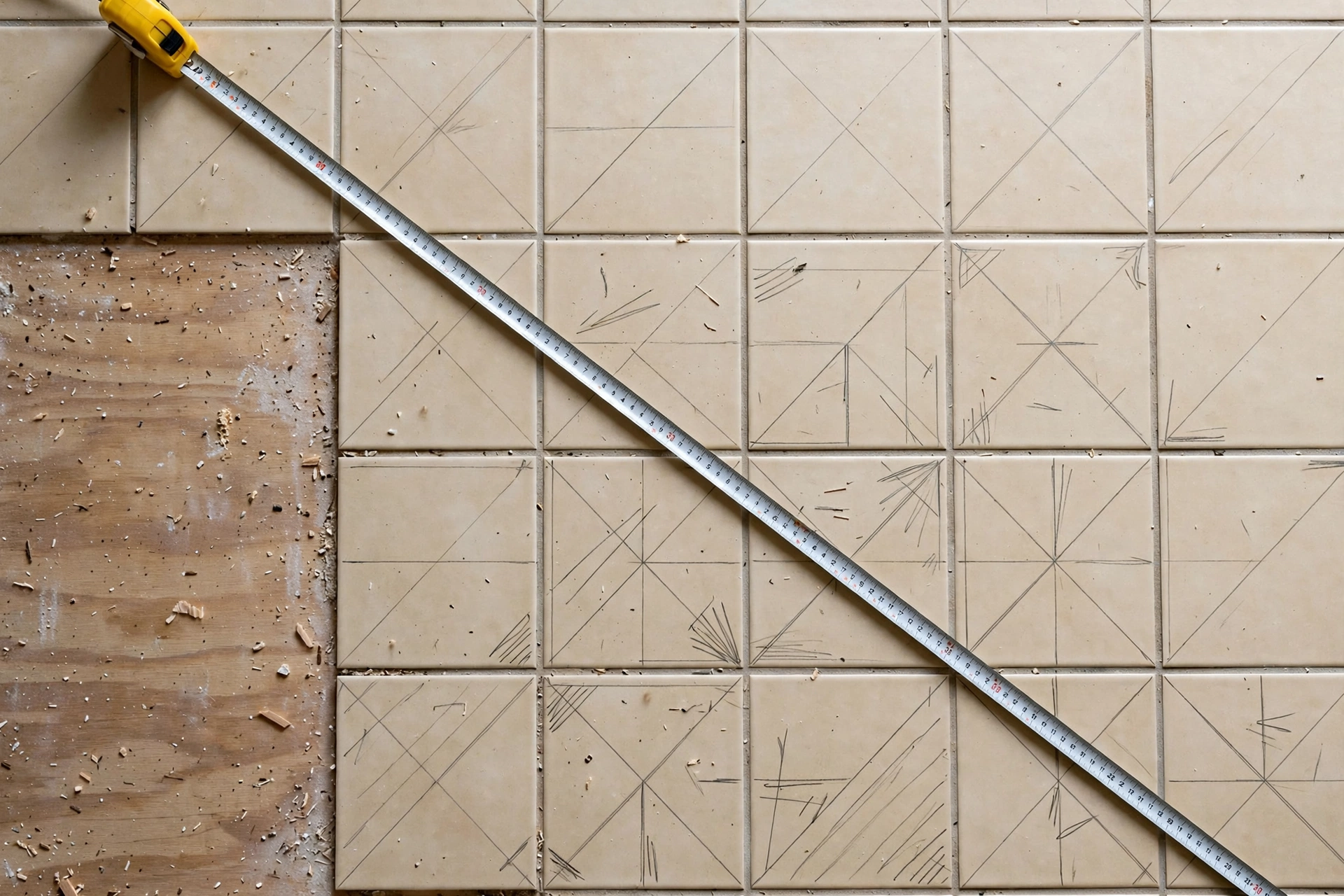
This is the question that separates a smooth weekend project from a stalled one. Tiles get cut to fit edges, corners, and doorways — and cut pieces can't be reused. Chips and breakage happen. And dye lots vary between production batches, so tiles bought next month may not match.
The rule the pros use:
| Your situation | Extra to buy |
|---|---|
| Simple square room, straight layout | 5% |
| Standard room with a few cuts | 10% |
| Diagonal pattern or curved edges | 15% |
| Complex cuts, lots of corners | 20% |
The formula: tiles to purchase = exact tiles × (1 + waste %), then round up. You can't buy 0.4 of a tile.
Back to our 12×12 room: 144 × 1.10 = 158.4 → 159 tiles. Going diagonal instead? 144 × 1.15 = 165.6 → 166 tiles. That 7-tile difference is the cost of the fancy pattern — now you know it before you commit.
Question 4: "How many boxes is that?"
Tiles are sold by the box, not individually, and boxes don't split. The math is simple but the rounding direction matters:
Our 159 tiles, with 10 tiles per box: 159 ÷ 10 = 15.9 → 16 boxes. Check the box label before you calculate — common counts are 8, 10, or 12 per box, and it varies by tile size and brand.
Quick reference for the popular 12×12 tile (1 sq ft each), 10% waste, 10 tiles per box:
| Room | Area | Buy (tiles) | Boxes |
|---|---|---|---|
| 10×10 ft | 100 sq ft | 110 | 11 |
| 12×10 ft | 120 sq ft | 132 | 14 |
| 12×12 ft | 144 sq ft | 159 | 16 |
| 15×12 ft | 180 sq ft | 198 | 20 |
| 20×15 ft | 300 sq ft | 330 | 33 |
Question 5: "What about my weird-shaped room?"
Two cases, both solvable:
Diagonal / patterned layouts: the tile count formula doesn't change — only the waste percentage goes up to 15%, because every edge tile gets cut at an angle and angled offcuts are useless. A 12×12 room on the diagonal: 144 × 1.15 = 165.6 → 166 tiles.
Odd shapes: the rectangle-splitting trick from Question 1. Sketch the floor, divide it into rectangles, add the areas. Our L-shaped hallway example: 64 sq ft with 12×12 tiles and 10% waste = 64 × 1.10 = 70.4 → 71 tiles, or 8 boxes of 10.
Question 6: "Can I just do this on my phone in the store aisle?"
Yes — that's exactly what the free CalcMint Tile Calculator is for. Here's how to run it, based on the tool itself:
- Section 1 — Room dimensions: enter
Room Length (Feet)andRoom Width (Feet). Both are required. - Section 2 — Tile dimensions & wastage: enter
Tile Length (Inches)andTile Width (Inches)— note the unit switch from feet to inches. Then pick yourWastage / Cut Bufferfrom the dropdown (it defaults to 10% Standard Room; options run 5% Simple Square up to 20% Complex Cuts). - Optional: enter
Tiles Per Boxfrom your box label to get the box count too. - Hit
Calculate Tiles →. (Results appear after the click — they don't update live as you type.)Resetclears the form.
You get everything in one panel: total tiles to purchase (with waste) including how many are waste, room area, exact tiles needed, per-tile area, boxes to buy, and gross coverage area. I ran a 12×10 ft room with 12×12 tiles through it: 120 exact, 12 waste, 132 total, 14 boxes of 10 — matches the hand math above to the tile.
Question 7: "What's the one mistake that costs people real money?"
It's not bad measuring — it's returning all the spares. Most stores take back full unopened boxes, so the temptation is to return everything left over. Don't. Keep at least one full box.
Why: tiles are fired in batches, and the shade varies slightly between dye lots. If a tile cracks in two years, a replacement from a new batch will sit there slightly off-color forever — a permanent reminder of the $40 you "saved." Spare tiles from the original lot are invisible repairs. This is also why tilers photograph the dye-lot number on the box before starting: if you do need more mid-project, matching the lot matters more than matching the brand.
One more money trap: buying premium tile for a rental or flip and then skimping on the waste margin. The tile itself is the expensive part — the extra 10% is cheap insurance on an already-expensive purchase. Saving $30 on waste tiles while risking a $2,000 tile order stalling mid-install is backwards math.
The rest of the greatest-hits list, so you can dodge all of them:
- Mixing up feet and inches — room in feet, tile in inches, convert with ÷ 144.
- Forgetting to round up — 158.4 means 159 tiles and 16 boxes, not 15.
- Using the 10% default for a diagonal job — that's a 15% layout; the dropdown exists for a reason.
- Measuring once — measure each wall twice; rooms are rarely perfectly square.
Quick answers
How many 12x12 tiles do I need for a 12x12 room?
A 12×12 room is 144 square feet. With 12×12 inch tiles (1 sq ft each) you need 144 tiles exactly, plus a 10% waste margin: 144 × 1.10 = 158.4, rounded up to 159 tiles to purchase.
How many boxes of tile do I need for 100 square feet?
For 100 sq ft with a 10% waste margin you need 110 tiles. Divide by the tiles per box: with 10 tiles per box, that's 11 boxes. Always round up — you can't buy a partial box.
How much extra tile should I buy for waste?
Buy 5% extra for a simple square room, 10% for a standard room, 15% for diagonal or curved layouts, and 20% for complex cuts. The extra covers cut pieces, breakage, and future repairs.
Do I need to account for grout lines in the tile count?
For most home projects, no. Grout lines are narrow enough that the standard waste margin (10%) more than covers the tiny area they consume. Just use the tile's nominal size in your calculation.
Can I return extra tiles I don't use?
Most stores accept returns of full, unopened boxes — but don't return everything. Keep at least one full box of spare tiles; dye lots change between batches, and a future cracked tile won't match a new batch.
How do I calculate tiles for a room that isn't a rectangle?
Split the room into rectangles, calculate each rectangle's area (length × width), and add them together. Then divide by the area of one tile and add your waste percentage.
The receipt test
Before you pay, run this four-point check. If all four pass, your number is right:
- ✓ Room measured in feet, tile in inches, converted with ÷ 144.
- ✓ Waste percentage matches the job — 10% standard, 15% diagonal, 20% complex.
- ✓ Tiles and boxes both rounded up, using the actual tiles-per-box on the label.
- ✓ One full spare box staying home with you — not going back to the store.
Four checks, thirty seconds, zero return trips. That's the whole game.